

Spoken Word
A Story About Perspective

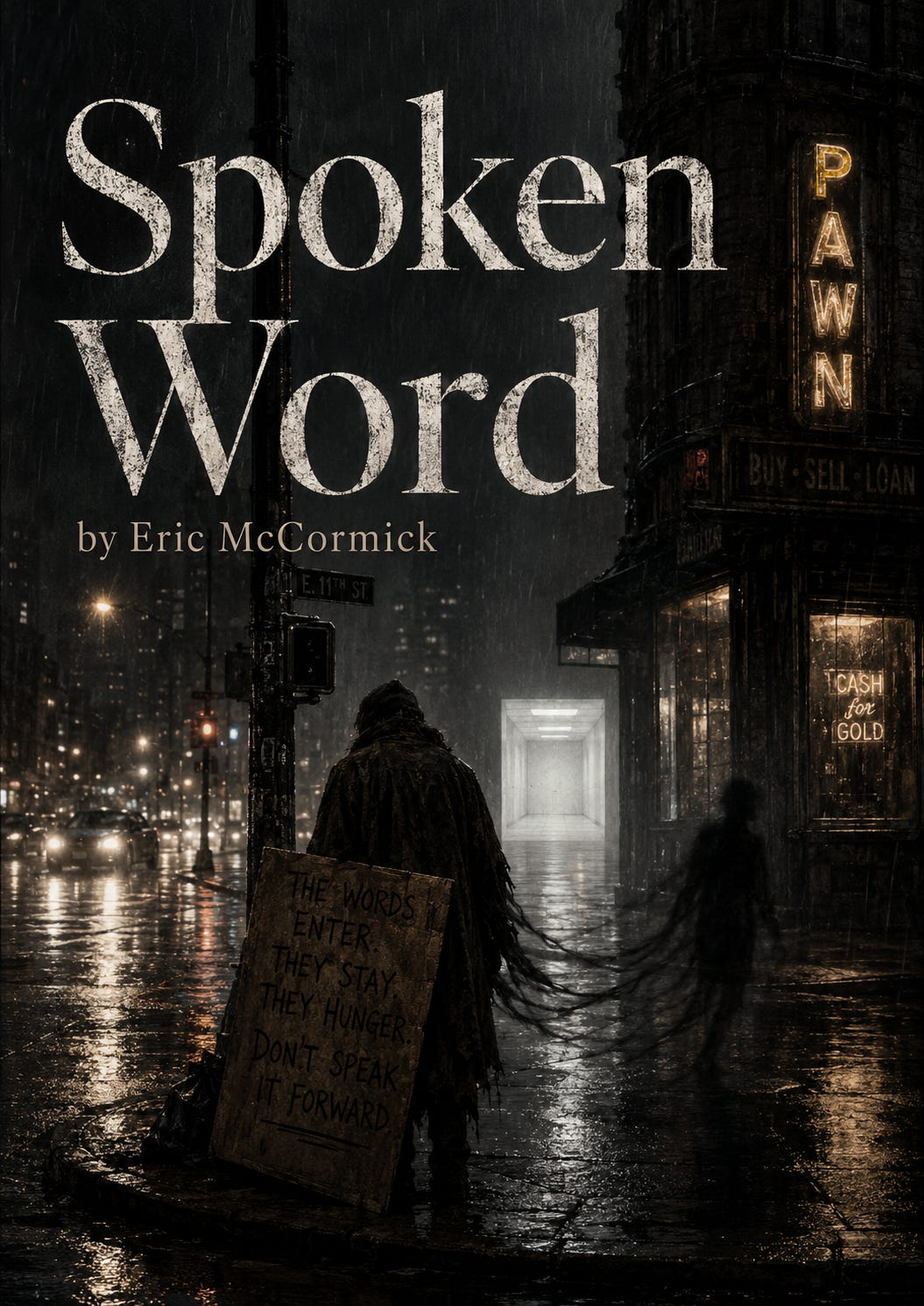
The cardboard drank the rain and curled in my hands. Marker bled into little gray haloes. I held the sign over my chest and let the cars splashing past read it. A bus hissed past. The light above the pawnshop flickered. The corner breathed slow, a thing that knows how to feed.
IT HAPPENED IN THE WHITE ROOM
I said it to the bus fumes. I said it to the boy who kept his hood up and filmed my mouth instead of my sign. I said it to the pigeons because they still understood hunger, and this was all about hunger. Everything is all about hunger. It's all that matters, at the end of the day. All that…
“What white room?” the boy tried to smile with a lip that could not commit. It was brave of him to talk to me. I know I look a fright.
“The one that wears your memory like a face,” I said. “The room that asks a question, and then moves into your answer.”
•••
He laughed.
He used to preach from a stage, with hot lights and four cameras aimed to find the moist flash in his eyes. He used to reference Romans and Ruth and whatever alliterated with the topic of the week. The megachurch looked like an airport lounge, with a cross unapologetically towering over the mass of people below. They called him Pastor… Pastor…
The name buzzes around him now, never landing. When he reaches for it, the syllables collapse into a hiss, hot oil kissing water. He thought, ‘It finds the handles and saws them off.’ His mind fumbles for a thing to grip.
•••
I stacked the other signs against the brick, a curled spine of warnings, and switched to the next one. The rain grew patient. Drops fattened, and fell, like slow lessons.
DO NOT LET IT BORROW YOUR VOICE
A woman in a red scarf paused. She smelled like oranges and fresh clean paper. Her eyes stayed kind, even when her eyebrows knitted above them.
“What borrows voices?” She squinted. “You look cold. Do you want soup?”
“It wants your mouth when it wants to move,” I said.
“What…?”
“The sentence that arrived when you could not find one,” I said. “The moment your throat stalled, the room filled it. You liked how tidy it felt.”
She hugged her coat closer. “You should go somewhere warm.”
“You should stop repeating your favorite thought,” I said. “It eats when you repeat it.”
She left with her shoulders angled, a glass on a wobbly table. Across the street a delivery driver hurried under the scaffolding. Styrofoam clacked. She watched him from under her hood. He watched her without appearing to. The city has many eyes.
I feel all the eyes now. They sit in the vents. They sit in cups of coffee. They sit in the little bright mirrors people carry in their hands. The signs move them. The words draw them. The predators like corridors and crowds, but they love the narrow tube of a thought that loops and loops and loops. Every loop polishes the edges. A polished thought passes through people without catching. It spreads faster when it slides.
•••
Noon pressed the traffic into a single living worm that turned corners without thought. The preacher pressed his back to the brick and changed the sign again.
IT FEEDS WHEN YOU REPEAT IT
A tall young man in a company jacket stopped and read. “Who feeds?”
“The one that taught you the fire escape dream,” the preacher said. “Wet stairs. Locked door at the top. You never had that dream until you heard someone describe it.”
The man blinked. He swallowed. “You are talking about memes,” he said. He used the word like an antibiotic.
“Memes do not take over rooms,” the preacher said. “This did.” He used to stand in the white room. He remembers that part as if he is still in it. The lights canceled themselves. The walls had no corners. The floor held him; a quiet lake can hold a man who walks carefully. There was a chair shaped like trust. He sat. A voice asked a question that could hold the weight of his entire life. He could not answer in time. The words, the words… The wrong words are so heavy. Something answered for him. He left the room with a sentence in his mouth that tasted like medicine poured over sugar.
He gave it away. He gave it to ten people the next day and it made their faces soften. He gave it to a thousand the week after, and the cameras loved him for it. What was the sentence? He tries to bring it into focus and the letters smear as if drawn on breath. It sits behind every other word like a seed behind a fig’s red mouth. He knows it by the trail it leaves. He knows it by the way people repeat it with relief.
•••
“You will carry it in your mouth until your teeth rot from the taste.”
I do not know who said that sentence first. I only know it speaks with my voice when I am bone tired; it speaks when I wake in the night and drink water in the dark; it speaks when a stranger says bless you and I hear the words miss and fall farther.
•••
Afternoon wore down to a wet blade. A dull razor, used and chipped. He gathered the signs like a troll collecting his shed skins. He carried the stack to the stoop of a boarded shop, where the flags above the windows had long since given up and turned to ghost cloth. Each one used to carry a message, lost now in the sun and the wind and the rain.
He sat on the curb and preached to the traffic. He preached to the rain gutter. He preached to the city, because the city survives on sermons. Even when it pretends otherwise.
•••
“You do not remember the white room, because memory is a wall you repaint,” I said. “It likes fresh coats.”
A girl in a plastic poncho stopped and took a photo. “Hold the sign higher,” she said. “It will read better.”
“Stop before you caption,” I said. She laughed.
“Never,” she said, and walked off with her reward already blooming under her thumb.
•••
Look at his mouth; the lines at the corners deepen when he pronounces certain words. Look at the way the tongue taps behind the teeth on the consonants when he needs emphasis. The hunger is a sound engineer. It listens for resonance, then shapes a living body into the instrument that best sustains it. It does not need to move furniture around, or soundproof the walls. It tilts perception by one degree. That is enough to change a life.
•••
A man in a long coat came and stood in the rain as though the rain were not happening. His shoes ignored the puddles around him. He watched with the focus of a person who knows where to bite.
“You were loud today,” the man said.
“I have to be,” I said. “It hums louder when I sleep.”
“You think people hear you.”
“I think people leave thinking they decided something on their own,” I said. “That is how it likes to work.”
“What does it want,” he said. It did not sound like a question.
“Space,” I said. “Not just in my head. In the rooms between us.”
He tilted his head. “You are building the house for it with these words.”
“I am pointing at the door,” I said. “The door…”
He turned and walked away, left without leaving a wake. Water beaded on the shoulders of his coat and did not slide off onto the ground. I watched him leave long after he was gone. I collected the signs when the light grew old and weary. I held the last one until the sidewalk emptied.
IF YOU SPEAK IT, IT SPREADS
“And now it is yours,” I whispered, to air that had earned nothing. I used to whisper into microphones, and the crowd would lean towards me as if that would enable them to hear me better in all that room. Different air. Same hunger. People wanted to swallow and feel fuller. I wanted to feed a god, a god that told me I could save a city with a sentence. The sentence had come. It vanished into minds and nested under tongues. It learned to purr.
The cardboard leaned against my leg like a dog that had chosen me without asking. I petted it and felt the pulp soften under the rain. My fingers smelled like marker and pennies.
A kid in a hoodie drifted closer. He picked up a sign from the stack without meeting my eyes.
IT ALREADY KNOWS YOUR ANSWER
“What does that even mean?” he shifted from foot to foot. The question came wary. The question arrived as though he had dragged it around all day.
“Tell me about the stairs,” I said.
“What stairs?”
“The ones that go up to a locked door,” I said. “Wet metal. Your hand sticks to the rail.”
He frowned. “You don’t know me,” he said.
“I know what it makes you think you dreamed,” I said. He blinked and dropped the sign. His sneaker smeared the ink as he left. The smear looked like a word trying to become another word.
The corner emptied. The rain paused as if it had been called for a quick meeting. The street breathed in a lazy way, satisfied with its diet of tires and shoes and the smoke of cheap cigarettes. I closed my eyes, and tried to remember…
the first time I felt clean. I found the white room again. Light without source. Walls without seam. A chair that pretended to put weight on the floor. I sat in the memory, and watched the memory watch me. A question arrived. I could not hold it; I had not earned that grip. A sentence slid into place where my answer should have been. The sentence smiled while the question went hungry. The room shed me back into the city with that sugar on my tongue. I fed the congregation first. Then I fed myself with their faces. Then the city learned the taste. Then the room had more rooms to fill.
Something shifted at my side. Brick does not move, but the spirits trapped in it can learn new habits. My shadow rose while I sat. My knees did not move; my hands did not lift. The shadow stood. It leaned. It cocked its head in a way my neck could not, not without pain. It lifted a hand and held that hand over my shoulder as if enjoying the heat of it. The shadow spoke without a mouth. The tiles of the boarded shop vibrated. The sound lived inside the sound.
You will carry me in your mouth until your teeth rot from the taste.
I did not look away. I listened the way you listen to a train arrive on a platform and you feel it through your knees. Fear had not come in that shape before. It came now, small and exact, feral and focused. It turned a screw somewhere in the idea of me and tightened once.
•••
He slept under the overhang with his signs pulled like a blanket over his legs. He dreamed of doors without hinges. He dreamed of mouths behind glass. He dreamed of a shadow that enjoys the honed edge of hunger and the clarity it brings. He couldn't remember any of his dreams.
Morning bled into him through his eyelids. Someone placed coffee beside his hand. He opened his eyes and found the woman in the red scarf staring at the sign that read
IT HAPPENED IN THE WHITE ROOM.
“I have not stopped thinking about this,” she said, and sipped. “What is the white room?”
•••
I pushed myself up. The coffee steamed and smelled like pennies and rain. That smell again. The city wears a single perfume, and it lets you pretend you chose something on your own.
“Tell me your favorite thought,” I said.
She smiled like someone pulling a forbidden toy from a child’s hand. “I do not have favorites.”
“You do,” I said. “Everyone does. They feed you sugar when you are empty. You repeat them when you want to feel like a person.”
She watched me for a long breath. “I like to say I only have enough energy for what loves me back,” she said.
“Stop saying it,” I said.
She tilted her head. “Why?”
“Because the room that gave you that sentence only loves the part of you that can be simplified,” I said.
She stared. She stared long enough to notice how my pupils had learned a new habit. She stopped drinking the coffee with me and left without speaking. The city swallowed her in one slow bite.
•••
He watched her go and prayed. Not to the old god of stage lights; he prayed to the pale technicians who live behind our sentences. He asked them for a failure. He asked them for one day when a divine phrase would fail to attach to his mouth. Predators hate waste, he thought. If enough phrases fail, the predator that feeds on them starves and moves on.
Please god or gods or other gods please move on.
The morning moved. The light along the pawnshop window turned thin and knife bright. People walked with faces that carried a single fixed idea apiece, as though the city had distributed them from a warehouse that morning. A man repeated, “Not my problem,” like a mantra, under his breath, at the crosswalk. A woman whispered, “I protect my peace,” as she knocked on a door that did not open. A teenager filmed himself saying the word, “Boundaries,” slowly, tired and proud.
The world loves a slogan, because a slogan keeps a shape even after the thing it described turns to ash.
•••
A boy in a soccer jersey stopped in front of me. The jersey had mud on it. “You crazy,” he said. He sounded curious, not cruel. I knew both very well.
“I am a street, that lost its map,” I said.
“You hungry?” He held out half a sandwich.
“Yes,” I said, and took it.
“Why you write like that?” he pointed at the stack of signs.
“Because things eat what we say when we do not think,” I said around the bread. “I want the city to chew before it speaks.”
He nodded, as if that belonged to his world, too. He kicked a bottle cap into the gutter with perfect weight and left with the walk of a person who has not yet chosen a favorite thought. May he stay empty long enough to fill with breath instead. I prayed, and prayed, and prayed.
Rain returned. The kind that believes it belongs here. People lifted their shoulders and kept moving. I preached into the beaded curtains of it and felt my voice press against a membrane and break through.
Sometimes I think the air has learned to catch meanings and sort them. Sometimes I think I am the one that adapted. By afternoon my throat burned. A man with a briefcase stopped and pulled a wallet and gave me a card without looking at me. The card read Cognitive Renewal Clinic. Seven affirmations on the back in thin cheerful font.
“Free seminar,” he said. “Reset your inner narrative.”
“Your white room needs better paint,” I said, and gave the card back. He blinked and took it. His shadow stood still while he moved. A small tell. Some shadows go to class; some have already graduated and came back to teach.
I turned the signs and found the one with the sentence that has always been heavier than the rest.
THE DOORS WERE NOT DOORS
“They were pictures of doors,” I told the bus driver when he stopped for a breath and opened his window. “You placed your hand on the knob and your hand learned to mimic the turning.”
“Where does the door go,” he asked.
“To the sentence you already carry,” I said. He nodded. He closed the window. He drove his route. He spoke into his mic and told people to move back and hold the pole and keep the aisle clear. The bus understood obedience. That is why predators like public transport. Ritual and repetition and faces that choose to not meet each other. At least not for long.
I kept at it until dark came back for me, and made meaning heavy. The streetlamps turned their haloes on again. The pawnshop shutter vibrated as it closed. I sat on the stoop and stacked the signs and watched the reflection of my own face swim in a puddle. The face did not feel like a noun anymore. It felt like a verb with its sleeves rolled up.
A presence collected beside me. Not the man in the long coat. Not anyone. The presence felt like a thought, bending toward itself. I looked at the brick. My shadow had learned something while I shouted. It did not sit. It did not crouch. It unfolded with a slow pleasure that made the hair on my arms choose a new direction. It rose until it stood over me. It tilted its head the way a crow does when it wonders if a coin tastes like food. It lifted its left arm and held it above my shoulder as if to measure the space between its palm and my bone.
The fingers curled. The wall accepted the curl like a lover. I smelled damp paper, old pennies, and the breath of a person who has rehearsed a prayer until the prayer devoured him.
I did not move. Movement would make it real, and I wanted to stay in the place where I could be mistaken. The shadow leaned close. The mouth did not exist. The voice did. It sounded like a thought that I’d already had settling into an old groove.
“You will carry me in your mouth until your teeth rot from the taste.”
The sentence had not changed. My hearing had. I heard it like rain on bone. I heard it like rats in a wall. I heard it like a thousand people saying the same blessing in a thousand kitchens and meaning a thousand different things while feeding the same thing.
I pressed my hands to my face and felt the heat of my own skin and knew it still belonged to me. The city exhaled in a way that felt like relief and warning. A bus sighed. A dog barked once at nothing and then again at something. The light above the pawnshop flickered and then held steady.
I lifted the last sign. The cardboard bent and straightened. The ink glistened. I faced the street and let the words wear me again.
IF YOU SPEAK IT, IT SPREADS
And I spoke, because silence is also food, and fasting makes it holy.
[All of my writing is published here for free. I appreciate any and all support of this publication.]
Solid work Eric 👍
Hail Heathen!
I think one could write a dissertation just on this piece...so much captured here - every syllable is placed with great intention and has a task - The pacing, POV switchbacks, sentence structure, brilliant imagery, weaving the wonder between sanity and insanity, truth and doubt, - I want to ask this mystic, preacher-turned-street prophet a question so badly!! Enjoyed it immensely!